|
PT
Classroom -
The Use of Continuous Passive Motion After
Total Knee Arthroplasty
׀ by
Chai Rasavong, MPT, MBA |
|
|

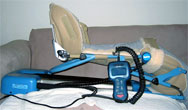
A continuous passive motion (CPM) machine is generally
utilized as soon as possible postoperatively for aiding
recovery after a total knee arthroplasty (TKA). The function
of the CPM machine is to move the knee joint slowly through
a controlled range of motion (ROM) to prevent joint
stiffness and the development of scar tissue. It has been
estimated by the president of an American company that makes
and sells CPM devices that, as of 2002, CPM was being used
in 17,000 hospitals in 77 countries and that about 7 million
patients had been treated using CPM (1). Although the CPM
machine may be a commonly prescribed treatment method, the
effectiveness of its use remains conflicting.
In a review by Brosseau et al. (2), they conducted a
meta-analysis of 14 studies to examine the effectiveness of
CPM following total knee arthroplasty. Their study concluded
that CPM combined with conventional physical therapy
increased the active knee flexion of patients who had
underwent a TKA by only 4° (and only at 2 weeks of follow
up) compared to physical therapy alone. They also found
through their meta-analysis that the use of the CPM machine
decreased the length of stay for patients by 0.69 days and
reduced the need for manipulation following TKA. In the face
of these findings the authors did question the clinical
significance of an additional 4° of knee flexion and
cautioned on the interpretation of the length of stay data
as many of the studies are historic in the terms of
contemporary lengths of stay following TKA (3).
In a study by McInnes et al. (4) they evaluated the efficacy
of CPM in postoperative management of patients undergoing
TKA by conducting a randomized controlled single blind trial
of 93 patients who participated in CPM plus standardized
rehabilitation vs. standardized rehabilitation alone. Their
study found that CPM patients achieved earlier motion and
had 7° more active flexion on post op day 7 than those
patients who didn’t receive CPM. However, by 6 weeks post
op, the range of motion in the two groups were virtually
identical.
In another study by Denis et al. (5), they conducted a
randomized clinical trial to compare the effectiveness of 3
in-hospital rehabilitation programs for ROM in knee flexion
& extension, functional ability and length of stay after
undergoing a TKA. Eighty-two subjects were randomly assigned
to 1 of 3 groups immediately after a TKA: a control group
who received conventional physical therapy only; a second
group which received conventional physical therapy and 35
minutes of CPM applications daily; and a third group which
received conventional physical therapy and 2 hours of CPM
applications daily. The results of their study revealed that
adding CPM applications to conventional physical therapy
interventions after TKA surgery didn’t favor increase knee
ROM, functional ability or length of stay.
From a review of these studies we can conclude that no one
study has been able to clearly demonstrate any long term
benefit from the use of the CPM machine after TKA surgery.
Besides the psychological benefits for a patient by using a
CPM machine, conventional physical therapy services along
with a home exercise program should be adequate for
preventing joint stiffness and the development of scar
tissue in most cases.
Last revised: January 11, 2010
by Chai Rasavong, MPT, MBA
REFERENCES
1.
Salter R. Continuous Passive Motion: From Origination to Research to
Clinical Applications . J Rheumatology. 2004;31:2104.
2. Brosseau L,
Milne S, Wells GA, et al. Efficacy of continuous passive motion following
total knee arthroplasty: a metaanalysis. J Rheumatolgy. 2004;31:2251-64.
3.
Bourne R. Continuous Passive Motion Improves Active Knee Flexion and
Shortens Hospital Stay but Does Not Affect Other Functional Outcomes After
Knee Arthroplasty. The Journal of Bone and Joint Surgery (American).
2005;87:2594.
4. McInnes J et
al. A Controlled Evaluation of Continuous Passive Motion in Patients
Undergoing Total Knee Arthroplasty. JAMA. 1992;268(11):1423-1428.
5.
Denis M et al. Effectiveness of Continuous Passive Range of Motion and
Conventional Physical Therapy After Total Knee Arthroplasty: A Randomized
Clinical Trial. Physical Therapy 2006 86:174-185
|
Please review our
terms and conditions
carefully before utilization of the Site. The information on this Site is for
informational purposes only and should in no way replace a conventional visit to
an actual live physical therapist or other healthcare professional. It is
recommended that you seek professional and medical advise from your physical
therapist or physician prior to any form of self treatment.
Copyright © 2005-2010 CyberPT Inc. All rights reserved.