

|
PT Classroom -
Serial Casting with Anterior Cut-Out to Increase Dorsiflexion ROM
׀ by Nancy Hylton,
PT, LO |
|
|
Nancy Hylton, PT, LO is a licensed physical
therapist who has more than 30 years of experience in pediatric physical therapy and casting / orthotics,
studying under the Bobaths and Mary Quinton, as well as other diverse treatment
approaches. As co-founder of
Children’s Therapy
Center, she has been involved in the development of dynamic casting/orthotic
systems and became a licensed Orthotist in 1998. Nancy has taught
internationally and has published numerous articles. Although her PT practice
has focused on infants and children, Nancy has had considerable experience in
treatment of adolescents and adults with a variety of neuro-motor and musculo-skeletal
conditions. Nancy will be presenting at the
Association of
Children's Prosthetic-Orthotic Clinics Annual Meeting in Clearwater, FL on
6/02/10-6/05/10. |
Serial Casting with Anterior Cut-Out to Increase Dorsiflexion ROM
In In our more than 30 year history using AFOs in children
with Cerebral Palsy at
Children’s Therapy Center of Kent, Washington,
we have found that a minumum of 90 degrees of ankle ROM into
dorsiflexion is needed for optimal Dynamic AFO fit. Full
weight bearing over the affected limb and the ankle movement
permitted by this style of AFO will encourage the
acquisition of the additional 10 degrees of tibial motion
over the foot necessary for typical progression in
mid-stance. Occasionally, children with Cerebral Palsy,
especially very active hemiplegic or diplegic patients,
arrive for orthotic consultation with limited functional
ankle dorsiflexion, R2 (maximum ankle dorsiflexion reached
by the examiner) greater than 90 degrees with knee
extended. This increased muscle tightness and functional
shortening is most often associated with periods of rapid
long bone growth and the inability of the muscle to stay on
active stretch long enough for the muscle to adapt its
length to the new bone length.
The plantarflexor group is one that typically can become
shortened in this situation, restricting the typical
movement needed to advance the body over the foot in
walking. Increased dynamic tension in the plantarflexor
group can be a compensation for different primary deficits,
including medial-lateral ankle and rearfoot instability, and
unpredictability of knee control and fear of knee collapse
during weight bearing. The first instance is related to the
normal ankle and rearfoot stabilizing function of the soleus
in weight bearing, and the second to the a primary function
of the gastrocnemius as a knee extension stabilizer in
weight bearing. In a person with motor control deficits,
these functions can cause excessive concentric activation of
the muscles and over-flow to other groups in an attempt to
stabilize the ankle or knee. Typically, eccentric muscle
control is used to manage these functions.
Serial casting is an established therapeutic tool to assist
functional muscle growth and soft tissue tension reduction
associated with rapid long-bone growth in Cerebral Palsy.
Serial casting is designed to put specific muscle group on
active prolonged stretch to stimulate adaptive muscle growth
to re-establish more optimal length-tension relationships.
In children with Cerebral Palsy, the eccentric and isometric
muscle contractions associated with active stretch and
prolonged stretch appear to be more difficult than
concentric muscle contractions. This and problematic
increased dynamic tension puts children with spastic
cerebral palsy at higher risk for decreased muscle growth
adaptation during and after long-bone growth spurts.
Our particular style of short-leg serial cast incorporates
an anterior cut-out which permits an additional 5 to 10
degrees of motion into dorsiflexion within the cast in
weight bearing. Very precise use of ¼ inch thick casting
felt permits a very tight fit with good protection for bony
prominences. The use of an initial layer of soft cast (3M
Soft-cast) provides compression which quiets hypertonus and
initial positioning of the foot and ankle. This is followed
by a layer more rigid fiberglass cast (Delta-lite Rigid) for
durability and final positioning. The anterior opening is
cut-out approximately 3 inches above the ankle bend and
permits excellent stabilizing and seating of the heel with
controlled motion into dorsiflexion. Protection of the tibia
is provided by an extra 1/4th inch felt cast padding at the
edge of the cut-out. The heel, malleoli and dorsum of the
foot are protected during the movement into dorsiflexion by
the very precise use 1/4th inch thick casting felt mentioned
above.
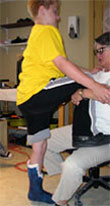
As a key component of our style of serial casting, children
are encouraged use active weight-bearing and balancing
exercises order to use the muscles in a lengthened range and
to strengthen more typical movement and weight-bearing
strategies in the casted leg. Therapists and parents
understand that this time in the cast is a “window of
opportunity” to develop more typical sensori-motor
strategies and strength, so children are encouraged to be as
active as possible to take maximum advantage of the time in
the cast. This combination of active or active assisted
weight-bearing strategies and anterior cut-out to permit
additional motion into dorsiflexion, appears to produce more
rapid improvements in functional range of motion and less
post-casting weakness in the children. A standard canvas
cast boot with flat rubber sole is use to maximize traction
and balance during weight bearing.
Last revised: April 6, 2010
by Nancy Hylton, PT, LO
|
Please review our
terms and conditions
carefully before utilization of the Site. The information on this Site is for
informational purposes only and should in no way replace a conventional visit to
an actual live physical therapist or other healthcare professional. It is
recommended that you seek professional and medical advise from your physical
therapist or physician prior to any form of self treatment.
Copyright © 2005-2012 CyberPT Inc. All rights reserved.